
Reading Music on Guitar and What Adult Beginners Need First
Adult beginners don’t need to read standard notation before they start playing guitar; how much reading they need depends on the music they want to make. Reading asks them to decode pitch and rhythm, choose a fretboard location, and coordinate unfamiliar finger movements together. Cognitive load offers a plausible explanation for the difficulty of managing those demands. Tablature provides a direct map of strings and frets, while Edwin Gordon’s music learning theory emphasizes hearing music before reading its symbols. Applying the expertise reversal effect to guitar suggests that learners may need different supports as familiarity grows, but it doesn’t establish one best sequence for everyone.
You sit down with the guitar in your lap and look at the sheet music. The symbols look like a foreign language, your hands feel clumsy, and an old familiar thought surfaces: maybe you aren’t musical. That thought deserves a closer look before anyone accepts it, because it rests on an expectation most people never examine.
Many people hold a deep cultural expectation that reading notation is step one of learning any instrument. The source traces that standard to traditional conservatory training, describing a system built centuries ago primarily to teach young children piano. That’s a broad historical account, and it doesn’t establish precisely how the expectation developed or how well it fits an adult beginning guitar. Feeling lost in front of that method says more about where it came from than about your musical ability.
Why a Guitar Isn’t a Small Piano
Expecting a beginner guitarist to learn exactly like a beginner pianist overlooks a physical difference: a piano keyboard is linear, and each pitch corresponds to one key. Middle C has only one location. The guitar works on a two dimensional grid, and because the strings overlap, that same middle C can be played in several different places. A pianist reads a note and presses the matching key. A guitarist reads a note and has to work out where to play it, based on whatever notes come next. That choice adds another task to everything else a beginner is already doing.
Research on musicians describes guitarists as relying heavily on visual spatial mapping. In plain terms, that means learning fretboard locations by watching hands and recognizing shapes. The source presents this as a general research finding without identifying a particular study, so the claim needs to be held cautiously. Its application to beginners is an inference: learning through shapes and imitation may place different demands on you from learning through symbols on a page.
Where Your Working Memory Goes

Reading notation on guitar asks you to manage several unfamiliar tasks together. Your brain has to decode a pitch, calculate its rhythm, find a fretboard location, and move your fingers into position. Educational psychology uses the term intrinsic cognitive load for the unavoidable mental effort a task requires, given working memory’s limits. Working memory is the small amount of information you can hold in mind and work with at one time. Those limits help explain why coordinating notation and unfamiliar movements can feel difficult.
Applying cognitive load theory to guitar notation offers a plausible explanation for that difficulty. The source doesn’t provide a measurement of guitarists’ working memory while they’re reading, and the explanation can’t establish the cause of any one person’s struggle.
If sheet music leaves you feeling paralyzed, the demands of the task deserve examination before you draw conclusions about your talent. The method may be asking you to coordinate more unfamiliar information than you can comfortably manage at once. That makes the way the task is set up relevant to understanding the difficulty.
What Tablature Does for a Beginner
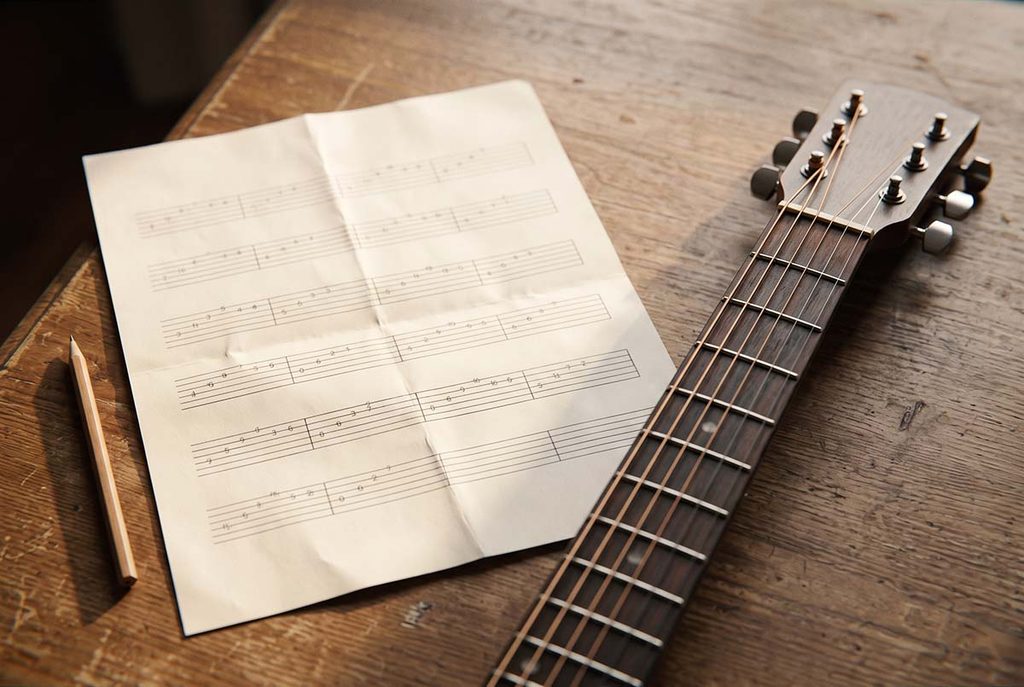
Tablature gives a beginner a direct map of the instrument. Tablature is six lines for six strings, with numbers showing which fret to press. It reduces the need to translate a pitch symbol into a fretboard location. You can see where your fingers need to go without first choosing among several locations for the same note.
Basic tablature has limits. It can leave rhythm and note duration unclear, and it doesn’t explain the harmony underneath the notes. Those omissions matter when you’re trying to play music you haven’t heard. For an adult beginner who knows how the music sounds, though, tablature can make recognizable playing possible sooner. That early reward may help keep you engaged.
Many adults think they failed at guitar because they couldn’t read music. Some of that frustration may have come from teaching methods that didn’t fit the instrument or the learner. That’s an interpretation of the difficulty, rather than a documented explanation of every adult’s experience.
Hearing Before Reading

Edwin Gordon’s music learning theory compares learning music with acquiring language. Infants listen and speak for years before they read. The theory emphasizes audiation, described in the source through internally hearing and physically feeling a rhythm, before connecting sound with written symbols. It holds that introducing symbols before sounds are internalized can add difficulty. A learner who has heard the music has something to connect the symbols to; a learner handed symbols first has to manage unfamiliar sounds and notation together. This is the theory’s account of learning, rather than a settled rule that determines the best sequence for everyone.
When Helpful Supports Stop Helping
The expertise reversal effect describes how supports that help a beginner can become less helpful as expertise grows. Educational psychology documents the effect, but applying it to tablature and chord boxes on guitar is an inference. As fretboard navigation becomes more familiar, a player may need different support from the support that helped at the beginning.
Applied to guitar, the effect suggests a possible sequence. You begin with tablature to build a physical map of the fretboard. As your hands navigate more automatically, you can add standard notation to develop your understanding of the music. Familiar movements may leave more attention available for reading and theory. The sequence fits the explanation, but the effect doesn’t prove that it’s the best route for every guitarist.
Reading Music Is a Choice, Not a Test
Musical literacy depends on what you want to do. A musician reading complex orchestral charts needs skills that someone strumming chords on a porch may never use. A songwriter sketching ideas has another set of practical needs. Those differences make reading a question of function and goals.
The source describes a hierarchy that treats sight readers as “real musicians” and players using shapes and tabs as less legitimate. That’s an interpretation of music culture, rather than a documented finding. If you’ve felt judged by that distinction, it helps to consider what the music you’re making actually requires. The best method is the one that keeps you engaged and keeps the guitar in your hands. Reading standard notation is a useful tool you can develop when you need it. It is not a test of your worth as a musician.
Matching the Method to the Instrument
On a piano, every pitch has one key; on guitar, the same note can occur in several places. Reading guitar notation asks working memory to handle pitch and rhythm while coordinating unfamiliar movements. Tablature supplies fretboard locations directly, although basic tablature can leave rhythm and harmony unclear. Hearing the music gives you something to connect those instructions to. As playing becomes more familiar, you can add notation according to your goals.
The method has to fit the instrument and the learner.
Your Hands Catching Up to Your Ears
You already have music stored in your memory, and you can begin making sounds before you learn to decode notation. Your hands need time to become familiar with the instrument. You are not starting from zero. Understanding your hands as catching up to your ears is a way of explaining hearing before reading, rather than a measured finding about your individual progress.
Sheet music felt impossible because it asked your working memory to do everything at once, and that does not measure your musical ability.
Cognitive load offers an explanation for why notation and unfamiliar movements can be difficult to manage together. Tablature reduces the translation between pitch symbols and fretboard locations, while Gordon’s theory provides a framework for hearing before reading. Applying cognitive load and the expertise reversal effect to guitar remains an inference, and attributing some adult frustration to mismatched teaching design remains an interpretation. None of this tells you how quickly reading will come. It gives you reasons to examine the demands of the method and to learn as much notation as the music you want to make calls for.
Frequently Asked Questions
Do adult beginners really need to read music to play guitar?
Adult beginners don’t all need standard notation from the beginning. The amount of reading you need depends on your musical goals. Strumming chords and reading complex orchestral charts require different skills. Tablature can support early playing, while standard notation remains a useful tool to develop when your goals require it.
What are working memory and intrinsic cognitive load?
Working memory is the small amount of information you can hold in mind and work with at one time. Intrinsic cognitive load describes the unavoidable mental effort a task requires. Reading guitar notation combines pitch and rhythm with fretboard choices and unfamiliar movements, placing substantial demands on a beginner.
What does visual spatial mapping mean on guitar?
Visual spatial mapping means learning where notes and shapes sit on the fretboard. Guitar strings and frets form a two dimensional grid, and the same pitch can occur in several places. Watching hands and recognizing shapes can help a learner connect musical sounds with physical locations on the instrument.
What is guitar tablature, and how does it help beginners?
Guitar tablature uses six lines to represent six strings, with numbers showing which frets to press. It gives a beginner a direct map of where to play, reducing the translation from pitch symbols to fretboard locations. Basic tablature can leave rhythm, note duration, and underlying harmony unclear.
What are audiation and Edwin Gordon’s music learning theory?
Edwin Gordon’s music learning theory emphasizes hearing music internally before connecting it with written symbols. The article describes audiation through internally hearing and physically feeling a rhythm. Its sound before sight sequence compares music learning with language learning, where listening and speaking precede reading. This is a theoretical framework.
What is the expertise reversal effect, and does it apply to guitar?
The expertise reversal effect describes how supports that help beginners can become less helpful as expertise grows. Educational psychology documents the effect. Applying it to guitar tablature and chord boxes is an inference: a player may need different support as fretboard navigation becomes more automatic, but no single sequence fits everyone.
Does struggling with sheet music mean I’m not musical?
Struggling with sheet music alone can’t establish your musical ability. Guitar notation can ask you to manage several unfamiliar tasks at once. Cognitive load offers a plausible explanation for that difficulty, although it doesn’t diagnose your individual experience. Examining the demands of the task can help you understand the struggle.
What does this establish about how adults should learn guitar?
The explanation supports matching the method to the instrument, the learner’s current familiarity, and the music they want to make. Hearing and tablature can provide a starting point, with notation added as needed. That sequence draws on established concepts, but its application to guitar doesn’t prove one best route.